


Modeling Memories and Stories
Growing up summers along the Boston and Maine White Mountain Route between Concord and Woodsville, NH, I crossed almost daily the tracks between Weirs Beach and Meredith in order to get to our beach on Meredith Bay. At this crossing, the B&M had located a pull-off for the speeder crews should they find that they needed to clear the track for an on-coming train. I watched this happen many times, usually noticing the look of serious concern and apprehension on the weathered faces of the crew, anticipating that an engine could suddenly appear from around the corner. This was not the time to dilly-dally. Their scrambling haste made for a rough maneuver and resulted in the speeder wheels being dragged around in a semi-circular pattern across the boards between the tracks, and then the speeder was leaned into, and with groans and grunts from these tough looking men that scared me, it was pushed onto the two spindly short rails that were perpendicular to the main line. Thus, the gouged out quarter-round scrapes on those boards.
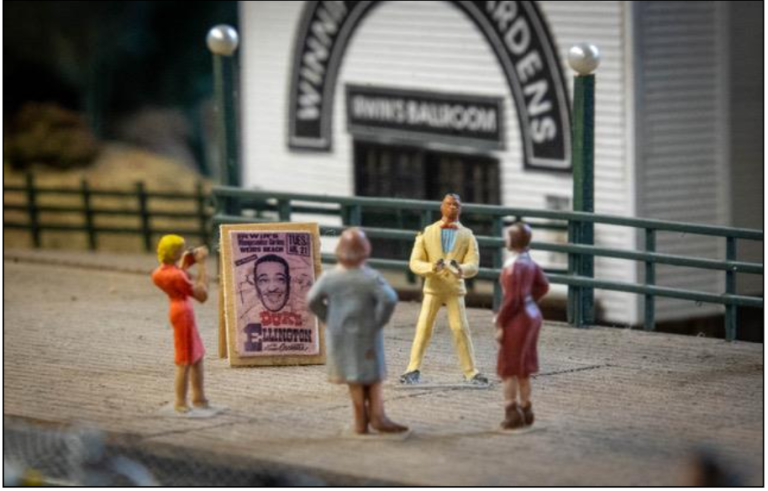
The Winnipesaukee Gardens at the Weirs in Laconia, NH, was constructed in the 1920’s by bandleader Jim Irwin as a venue for his band and others. Through the thirties, forties, fifties and even into the early sixties, all the famous dance bands appeared. While a college student, I worked in the Half Moon snack bar across the street. It wasn’t unusual for the band leader to wander along the Weirs boardwalk prior to the show, engaging with fans. You can see by the billboard that Duke Ellington is in town tonight and sure enough, he is out strolling. I’ll bet the folks he meets are really excited and can’t wait to tell their friends that they talked to the Duke himself at the Weirs!
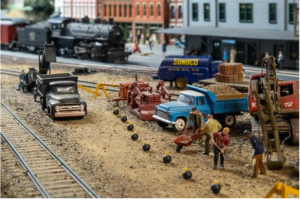 Remember smudge pots? I do. As a kid, my house near the Reading Highlands steam locomotive service area and wooden commuter car storage tracks provided a great draw for our neighborhood gang. After taking in the action, we would often mosey down the tracks a half mile or so to a little used country road crossing. This road was always in poor repair and so the town was constantly digging and filling there. Since the work never seemed to get done in one day, the crews would leave some rickety wooden horse barriers and several lit smudge pots to warn motorists. Dusk was the best time to go. The crew was gone and the pots were lit. Now we weren’t destructive nor did we take the pots. We did, however, rearrange the pots to our liking and to our credit (I think), would take a small pine stick to catch the flame from a lit pot and re-light any which had gone out. Community service at its finest.
My daughter is a research professor at the University of New Hampshire. Believe it or not, her research involves the testing and development of asphalt. One day, while visiting my layout, she exclaimed: “Hey Dad, you don’t have any paving going on here!” Not one to let an idea drop, she soon had a colleague at UNH sending me pictures he had of paving machines from the late 1940’s and early 1950’s.
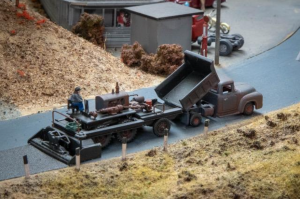
Now, you all know that lighting enough of a fire to get a project started is often the biggest obstacle, and so this idea festered in a smoldering glow for a couple of years. Then, at a train show, I came across an HO road grader. Somehow I could see a paving machine in that grader! I started by making the frame and receiving hopper from styrene. Then the grader was taken apart. The blade was turned down flat to form the asphalt applicator. The steering wheel became the height adjuster for the applicator. The drive train simulated the gearing of some sort which I could see in the old photos. All six wheels were used and actually were quite close to the wheel arrangement in the pictures. The motor became the exposed motor seen on the 1940’s machines. Some wire for railings and controls and a styrene seat for the operator were fashioned. Details such as oil cans and hoses were added. The newly applied pavement is a strip of emery cloth. Now I can repave all the roads on my layout.
A group from our operating bunch were returning from a train show in Bethlehem, NH and we decided to stop in at the restored Ashland, NH railroad station to look around. Another car was in the lot and an elderly gentleman was wandering around. This turned out to be Ray Welch, Jr., whose Dad, Ray, Sr., was the station agent here in Ashland and at many other stations on the B&M on the early part of the 20th century. Talking to Ray we learned that he had a younger brother, Harry Welch. Both became good friends and were active fellow model railroaders in our ops group for several years. They each had wonderful stories of life with their Dad around the railroad. Here’s a short tale about Harry as an 8-year old in Ashland:
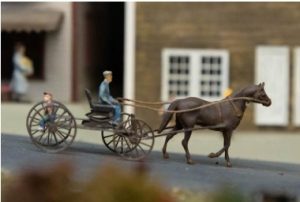 Harry attended the Ashland school which was located on a hill near the center of town. His house, however, was down near the station, about a mile away. Mr. Gardner operated the sundries store in town and at about the time Harry was getting out of school, would hitch up his horse to his buckboard and make the trip to the station to pick up the evening papers and other stock which had come in on the afternoon train. Harry would run as fast as he could and jump onto the back of the buckboard giving himself a free ride home. Evidently Mr. Gardner was ok with this arrangement but wasn’t about to wait around for Harry, so he had to move fast. Pretty resourceful young fellow was Harry, wouldn’t you say? Not surprisingly, Harry went on to become a pilot and navigator in the military and also was the Captain of the Motor Vessel Mt. Washington on Lake Winnipesaukee for many years.
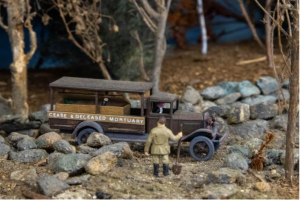 Silas Ebenezer Farmsmith was the town grave digger. When there had been a funeral he always tried to be at the cemetery early enough to prepare the gravesite out of view of the grieving family of the recently departed. On this day, however, his wife, Florence Foulweather Farmsmith, had been unusually persistent in her demands for him to finish splitting the peas for her famous split pea soup which she intended to make later that day. This of course made Silas Ebenezer Farmsmith a bit late and so he arrived at the cemetery just in time to see the hearse pull up the dirt road and pass him bye. Silas Ebenezer Farmsmith was a simple but observant fellow and he couldn’t help but notice that something was out of the ordinary this day. Strangely, the lid on the coffin didn’t seem fully shut and lo and behold, as the hearse passed, the lid actually rose further. Startled at first, Silas Ebenezer Farmsmith took it in stride as he just happened to know the now not-so deceased contents of the coffin was a crusty old codger who never wanted to die in the first place. “. . . ‘peers he got his way” Silas Ebenezer Farmsmith said to himself under his breath as he turned and headed back home, his grave digging services evidently not needed. I don’t know the final outcome of this story, but I do know that Silas Ebenezer Farmsmith spent most of that afternoon splitting peas.